An orchid has survived and my birthday comes anyway

posted by admin on 2009.07.06, under Bipolar Disorder, Bipolar Research, Sean Costello
06th

I have written a lot about Sean and how wonderful he was as a person and son. All of that is true. I have also chosen to advertise that he was diagnosed with bipolar disorder, type II, which is primarily depressive with hypomanic episodes. What does that mean? I have received some odd responses from people who didn’t know Sean. Somehow, I get the impression that people thought that he acted crazy, “mentally ill.” When you talk about a child being a diabetic, since the presentation and extent of that diabetes may vary from person to person, there is no perception of that person as acting or being one way. When you say that your son was bipolar, there is a stereotype that people seem to apply. If you knew Sean, you wouldn’t be able to consider him “mentally ill” in the stereotypical sense. In fact, most people didn’t know that Sean had emotional challenges.

People who suffer from this disorder and their families know how difficult and exhausting it is, but it is largely a private battle. Most of the time, people act normal. Even in children, they are able to keep it together to avoid being “different” and then decompress at home, typically with their parents. In adults, it would be their partners who might get the brunt of their moods. I read once that a good description of bipolar disorder is getting stuck in periods of depression or anxiety. Everyone has episodes of depression, it’s part of the human experience. Most of us feel anxious from time to time: exams, new job, etc. When a person has bipolar disorder, the moods may  come more frequently and last longer, often without apparent provocation. It’s like a switch gets turned on that can’t get turned off. As the mind processes the anxiety, sleep becomes problematic and sleep deprivation just compounds the problems. In a way, it is the brain version of a blood sugar problem. Why do some people’s blood sugar stay elevated or plummet?  We know that it’s insulin; yet, there are some people who do not respond to diet or medications and progress to complications of the disease. Our brain functions just like everything else in our body – chemically. There are pathways that require enzymes, proteins, hormones, etc for the mechanism that controls moods to work properly.  While we might know what triggers hyperglycemia (high blood sugar), we are learning what triggers a manic episode.  We have a sense of what causes episodic depression, like a death in the family or chronic illness, we don’t know how depression functions when someone suffers from mixed mood states. In fact, medications that work for depression often make the person who suffers with bipolar disorder worse.

What I’m trying to say is that people who have this diagnosis look just like you and me most of the time. They are bright, engaging, appropriate in most of their interactions (of course, if someone is in an acute manic or depressive state, this would not be true).  It is because they act normally in so many ways that the disorder goes undiagnosed for 8-10 years on the average. During that time, since the sufferer wants to be “normal” and there is no one telling them what is going on, they learn to self-medicate. If I’m tired, I drink coffee to get going. If someone is chronically anxious, and there is no intervention, they might drink to calm down or try to sleep. This cycle of anxiety and depression calls for alternate methods to control the symptoms to survive. The result is obvious. Now the person who is bipolar, but has not been diagnosed or given appropriate medical intervention, starts to depend on these substances which bring their own series of complications.

For people who are living with these unexplainable mood variations, they know the toll they take on themselves and their loved ones. Like the rest of us, we reveal ourselves to those we trust. Given that they, too, are unprepared to handle what they don’t understand, the situation often deteriorates, causing divorces, breakups, family rifts, etc., all the while making the person more and more depressed and hopeless.

I knew that Sean was different emotionally from when he was a toddler. He had two moods: funny and engaging, or frustrated. He absorbed every word that was said and responded to music from when he was a baby (Sesame Street Fever being a favorite!).  He was bright, quick, adorable, funny and so well loved, and yet, he was so shy that it was debilitating.

gijoe

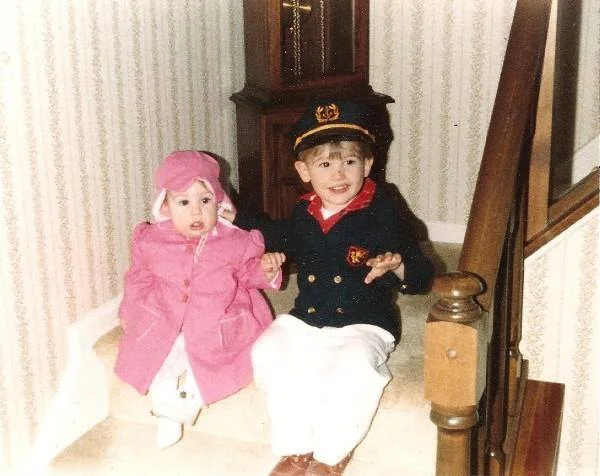
At age 3, he was to go to nursery school. He would only be comfortable if he were in “costume” like a cowboy outfit, GI Joe, etc. Nothing was odd looking about it; he was 3 after all. He got sick a lot and missed many days of school, something that continued throughout his lifetime. Because he was in the gifted program and a favorite of teachers and students alike (he was always chosen to play some funny part in plays, etc.) it never occurred to me that he was regrouping… that he needed that time off to be able to function in front of others. If you were to ask his teachers or classmates to describe Sean, they would say: quiet, adorable, smart, creative, polite and well liked. I don’t know what Sean would have said about himself, except that he often told me he felt like he didn’t fit in.

Because I divorced Sean’s Dad when he was about 5, Sean and I had a special closeness. (Actually, we always did have kind of a psychic connection.)  He would tell me his feelings openly and I tried everything that I could to get him to feel comfortable socializing. I wanted to take him to a counselor when he was about 6 or so, but was advised not to… it would make him feel responsible for the divorce. (Funny, though, I hear Sean’s biggest disappointment about the divorce is that we weren’t on Divorce Court!! So Sean, to look for something dramatic, while seeming insulated from the emotion. Or, maybe we just did a good job convincing him that it had nothing to do with him….)

By middle school, Sean had adopted the guitar as his sidekick and a way to gain access to acceptance.  This was in his mind, as he was already well liked and in every way visible, a normal kid. I sensed something totally different. Sean just didn’t feel challenged, or that he fit in. There are so many stories of this, most of them humorous. Then around age 12, he befriended boys who liked to get into trouble, and he did with them. Nothing major according to counselors, just normal boy stuff. I didn’t see it that way and had him go to counselors, something that continued throughout his life. The thing is, no one recognized a problem. Maybe he was depressed. Maybe he had ADD (he wasn’t hyperactive, so ADHD didn’t apply). Mostly, they told me he was smart, funny, self-aware and normal. No diagnosis, no intervention, no prevention of what was to evolve.

Now we have a 15 year old guitar prodigy singing and writing songs about the blues, and acting as a band leader to people much older than he. Ask any band member, and there was no question who was in charge. His stepdad traveled with him to oversee and protect him, but how do you resolve the emotions of a 15 year old with the intellect that was required to do what he did? Who were his friends? What were they doing on off times? Where did he fit in?

I demanded that he finish school and try to keep as normal a life for his age as possible. Given that Johnny Lang was allowed to quit school, I wasn’t very popular with Sean. In fact he turned 18 in April, 6 weeks before high school graduation, and told me he was dropping out of school because it was “the nobler thing to do.”  My response was “it was the stupid thing to do” and I forced him to continue, albeit through home school. If you haven’t figured it out yet, life with Sean was amazingly interesting and unbelievably exhausting, and we were very honest about our difference of opinions. He was reading Jack Kerouac and I was taught by nuns and a catechism, as well as a German father. There is no clear path for a person so gifted and concomitantly so variable in self-esteem, energy, vision, feeling of belonging, etc. I just fought to keep him grounded. So many things about the life of a musician and fame are subjective, fleeting and false.

The reason why this disease is so dangerous is because it is insidious. You cannot look at someone who is bipolar (unless they are an extreme case and/or in an acute manic state) and recognize them.  We all experience ups and downs, and most of them we keep to ourselves or share only with those we love. They are no different. In Sean’s case, as in most I assume, he had to keep his anxiety and depressions to himself in order to perform. I know he had panic attacks before every performance. Who would have known once he got on that stage what it took from him to get there? I did, and that knowledge interferes to this day with my being able to enjoy the beauty of his talent. It also caused friction between us, as I would try to get him help just one more time in just one more way.  The promises that mental health professionals give and don’t keep, the claims that they make for their ability to help, when they fail, just worsen the depression and erode hope for family and their loved one.

Sean was funny, hysterically so, entertaining, loving, generous, kind, talented, handsome, empathetic, wise; but, he was also angry, short-tempered, self-deprecating, easily agitated, self-involved, unsure, anxious, sleep deprived, disappointed. In other words, he was just like the rest of us, the difference being the magnitude of these feelings and the length and breadth of their effects. Nonetheless, let us not let anyone call someone with bipolar disorder “crazy” anymore than a diabetic would want to be called lazy or fat or ignorant. Sean needed a correct diagnosis, education about the effects of his diagnosis, ways to retrain his thought processes, effective ways to help sleep issues, medications and/or other interventions to reduce anxiety and relieve depression. This is what this Fund in Sean’s name is about. It’s about reducing the time that it takes to diagnose by teaching families, friends, teachers, counselors, doctors, how to recognize bipolar disorder before complications of self-medication. It’s about giving the sufferer the knowledge to know what is real and what is distorted thinking because of a chemical imbalance. It’s about giving every Mom who knows the suffering no one else can see the tools to advocate for the children they adore. It’s about removing the stigma of the diagnosis so that people don’t hide in shame, fearing that people will think they are crazy.

There are some key things that I would want everyone to know:

Bipolar Disorder is more genetically linked than any other psychiatric disorder. What does this mean? It means that we need to know the mental health history of our family tree. Who has been known to be depressed? (I believe that alcoholism is a form of depression.) Committed or tried to commit suicide? Have some undiagnosed mental health disorder? Been diagnosed as being bipolar? This is such a huge key to unlocking the correct diagnosis.

Bipolar disorder has the highest rate of attempted and successful suicide of all psychiatric disorders. (It is said that people don’t want to die. They just want rest. I know that was true of Sean. How so very sad is that?)  Given that suicide is one of the leading causes of death in ages 14-21 and bipolar disorder’s onset is typically in adolescence, catching it early and applying appropriate interventions might be saving many of our youth, many of which are our best and brightest.

There is nothing that will erase the sadness of the loss of a child, regardless of age or reason. It just is a violation of the laws of nature. Old should die before young. There is nothing I would not have done for Sean, and in my capacity, did for Sean. I would, if I could, switch places with him today. There is no joy that doesn’t come attached with a feeling of guilt or loss; no occasion that isn’t bittersweet. The world is never the same. There is no person who was more loved and cherished than our only son, and his sisters’ only brother. If you knew him, you know the hole is immeasurable and eternal.

I have exposed Sean’s challenges, because the world chooses to concentrate on a person’s demons without the context of their life and soul. I also push through the days that remain for me because I have other children whom I believe need to live the remainder of their life with some sense of the world being an okay place. If my view has changed, I at least had 50+ years of hope and optimism. I also know that Sean loved. Anyone who knew him knows that he loved with a passion and with a naivete that spread that joy and love to everyone that he encountered. I believe he would want two things from me if he could ask: (1) that I try to spread his music. It was his life, his meaning, his gift to us. ; and (2) he would want me to help his friends. He didn’t like the medical community and often used me to gain entrance and the support he was afraid they wouldn’t give him. He was embarrassed and awkward and just couldn’t understand why he felt the way he did. His perception was that the medical community would blow him off because he was a musician, didn’t make a ton of money and was relatively young. I don’t know how much of that is true, but if he believed it, it was true to him.  He fought with me, hugged me, pushed me away, helped me, all of those things that kids do to their moms, but he always asked me to help him when he felt like he needed help from the world of doctors and counselors. I think he would want me to help others, and now that I know more than I knew before, and am disappointed and, in fact, angry at their failing him, I cannot escape from helping others in his name.

If I could tell someone who suffered as Sean did anything, it would be to learn as much about your challenges as you can and find the best people possible to help. You are not crazy. You are not hopeless. You are loved, I am sure, by so many people. Accept their love and help. There is hope. I am hoping, that through your help and the help of others who contribute to this cause, that the hope will be magnified.

Wednesday is my birthday. Sean always said that I turned everything into an extravaganza. I know that I did use every chance I could to celebrate something, as celebrations are too few and far between in our culture. I guess I also sensed that we never know if we will have another opportunity to celebrate. I am so glad that I annoyed him with my extravaganzas. I may be poorer now than some, but look what would have happened if I put it all into an IRA anyway!!  At least I have the memories, and when I’m old and probably broke, I will still be able to remember that I helped Sean and Bridget live their dreams… that was my job. Unfortunately, I’m not really up for extravaganzas and hope for a quiet birthday that passes quickly, as I will be waiting for that one phone call.

When I despair of this life, as I don’t understand much of it anymore, I see this orchid that friends of Sean’s gave to me the day he passed. I am horrible with plants!!  My ex says that I have a black thumb :)  and orchids, well forget it!  After it bloomed, nothing was left for almost a year but a stick. I was so tempted to throw it out, but just couldn’t (way too sentimental). The other day, it bloomed three gorgeous flowers!! It’s hardly believable, especially since it’s me who is its caretaker.  I have chosen to view this as a sign of life’s cycles and that there is rebirth. So, on my birthday, when I blow out my candles, I will be wishing that Sean is in a place where everyone loves his music, where he is playing with Donnie and Nappy and smiling from ear to ear, and where he is at peace with himself.  Most of all, I want him to know that I love him, always have, am proud of him, always was, and my only hope is that I will be able to see him again, and maybe, just maybe, if he would come to me in a dream for my birthday.  If I can grow an orchid, anything is possible……….

The 1st Annual Sean Costello Memorial Fund Benefit Concert – Event Summary

14th
Sean Costello Memorial Fund Benefit Concert

The First Annual Sean Costello Memorial Fund Benefit Concert

I’m guessing that Sean was saying “There will be a snowstorm in Atlanta  in March before my Mom could pull off a benefit with Lurrie Bell, The Wood Brothers, King Johnson, Felix and the Cats with Jon Liebman and Soul Shakers.” Either that, or “If I can’t play with Lurrie Bell, no one can.” I am told by a friend of Sean’s and mine that Bob Dylan once said that weather was the great equalizer. Whatever the reason, fate deemed that Atlanta would have the first snowfall of the year the day of our concert and today it’s in the 70′s!

As it turned out, what looked like blizzard conditions, faded to dry roads with no accumulation. It snowed just long enough to scare some who would have come enough to stay in their homes…at least some of them. For the people who flew in from Chicago, they were wondering what the fuss was all about. Snow or not, the concert proved to be a great success with representatives from Chicago, Las Vegas, New York, France, Florida, Virginia, North Carolina, Indiana and Michigan…..

We apparently had planned the organization to the point where our committee and volunteers often seem bored, while people commented on the professionalism of the entire event. Things went smoothly in every area from ticketing to food to merchandise. Most importantly to the attendees, the concert itself went without a hitch and offered phenomenal music while a slideshow of Sean was running on screens on both sides of the stage. (I must admit that the slide show prevented me from enjoying too much of the entertainment, but I thought that it was a beautiful way to incorporate Sean into the program.).

Die hard fans of Sean and the bands came in numbers great enough to tell us that there is an audience for our cause. Several of our sponsors didn’t venture out in the weather, and we know many others who sent messages asking us if we intended to cancel. In all, I estimate about 150 people bought tickets, with the remainder present being staff, volunteers and musicians.

There are some wonderful and heartwarming stories about people’s determination to get to us. Chris Wood lives in Woodstock and was refused entry onto his plane because of his stand up bass. He drove to Newark (about a 2 hour drive), paid for the bass’ passage and arrived without a word of complaint. Lurrie Bell proved to be the nicest man with an obviously generous heart. He suffered through 4 plane changes and a 2 hour delay, but managed to arrive in time for his performance, and what a performance it was!  Such a quiet man to turn into a force of nature on stage. I hope Sean was watching.

I cannot say enough about the quality of the music and the demeanor of the musicians. Sean would have been so honored, and I certainly was honored in his behalf. I was moved to tears to feel so much love for him and support for our cause. Lisa Love was an awesome emcee with the best job ever: introducing the Soul Shakers, Felix and the Cats with Jon Liebman, King Johnson, The Wood Brothers and Lurrie Bell. I would not pretend to be qualified to critique any music, but a tone deaf attendee wouldn’t have words to express the unbelievable talent that graced the stage in Sean’s honor.

Our goals were to break even while getting the word out about the seriousness of bipolar disorder and the work of our cause, all the time keeping Sean in our thoughts as our catalyst. We more than met what we sent out to do. For example, there was a lovely older couple from Savannah who told me that they happened upon Sean by accident one day. They were ambling around the City Market when they heard some phenomenal music that happened to be coming from Sean. From that point on, they followed him whenever they could. This night they came to celebrate Sean’s music and to support the Fund. They have a very close relative who struggles with bipolar disorder and they know first hand its devastation on their loved one and the entire family.

As I said on Sunday, none of this would have been possible without the hard work of our fundraising committee. I will list them alphabetically, as each of them provided one part of the perfect combination that led to Sunday’s success: Lauren Arno, Melissa Bauer, Patti Beaman, Bridget Costello, Bartley Cross, Allison Dellamaggiora, Jon Liebman, Donald Schellhaas, Kelli Stripling, Megan Tackett, Manda Pullen Turetsky, and Lindsey Warren. In addition to these incredible people, there are many others who deserve our thanks for their generosity, including: Reggie Colbert and North Atlanta High, Jeff Bakos, Tom Dausner and Vincent Tseng, Matt Harper of Fat Matt’s Rib Shack, Tom Hyslop, Lisa Love, Iain Martin and Andy Whitaker.

The weather may have affected the number of people who were able to attend, but it certainly had no effect on the generosity and enthusiasm of those who did brave the weather. Our silent auction was a phenomenal success. Manda organized it as if she worked for Sotheby’s! Stephen Talkovich’s beautiful hand crafted guitar was purchased by Gary Leiffer; the phenomenal painting by Eileen D’esterno was bought by our board member, Richard Bolton, and gifted to me!  There were tickets to Levon Helm’s Midnight Ramble as well as DVDs and CDs, beautifully framed and matted prints of Sean by Keith Taylor, prints of Sean from 1998 donated by Evan Waller and more recent prints from Jerry Novick. Other auction donors included: Acupuncture Works, AnyHaul.com, Blind Willie’s, Carol’s Linens of Macon, Dan Seevers, Delta Groove, Donald Schellhaas and Ronda Wenger, Eby Designs, Landslide Records and Natural Body Spa and Shop. The charity of the people who donated and purchased these treasures is beyond gracious.

Despite the weather, we were able to cover the costs of the event through the generosity of our sponsors: Sonia Livingston, Northside Tavern, One Consulting Group, Maddy Moneypenny, Enercon, Blind Willie’s, and Amy Pollick and Josh Lipman as well as members of our Donor Circle. We also received in-kind donations from Costco, Datadirect, Fat Matt’s Rib Shack, Meanass Bear Graphics, Mellow Mushroom Pizza Bakers, Noize Productions (all the way from Buffalo!), Ticket Alternative and last, but not least, Tiny Design Studio.

This was our first effort and I am so proud of the result. I was very disappointed that some of the people who loved Sean were unable to attend and hope that next year, it won’t snow!

I have been asked what it is that we will do with the money we have collected. It is important to know that we consider every dollar donated as an obligation to use it to support our mission. On Sunday, for example, we donated a guitar of Sean’s and a scholarship in his name. Because they had nothing to do with Bipolar Disorder, these were family sponsored and did not use the Fund’s money. We are just beginning; however, the support and momentum has been so great, so fast that we have to catch up operationally. The donations have been respectable, but certainly will not build a facility, or support funding for mental health care. All of our staff are volunteers and every penny goes into the Fund. Over the next few months, I will be meeting with our Board and our Scientific Advisory Board to establish the steps we need to take to accomplish our mission. Each step of the way, I will keep you informed. So far, just the fact that conversations are starting
about this disorder is a step in the right direction, and as Sean said so eloquently, “There’ll be no half steppin.”

Sunday was representative of the intersection of the love for Sean and his music and the recognition of the needless tragedy of his passing. Through his light, we hope to improve the future of people who suffered as he did. It’s “All I Can Do.”

Bipolar Disorder in Children – Part 1

posted by admin on 2008.09.23, under Bipolar Research
23rd

I thought I should start this bulletin with a reason to care about Bipolar Disorder; especially, why we should care if a celebrity suffers from the disorder. To see even the slightest impact of this disorder, please click on the following link. What you will see is that some of the best and brightest people in history have been determined to be bipolar. The beauty, the music, the business and political contributions they have given us are immeasurable.

http://www.realmentalhealth.com/bipolar/bipolar_celebs.asp?gclid=COWgpfaa8JUCFQEuxwod2Uh4eQ

Now just imagine what the world would have been like without them and their talents. Unfortunately, many very special people are lost to this disease before they are able to leave their unique mark on the world at large. Many, many times they are lost because of dependence on drugs and/or alcohol. This is why the number one priority needs to be early diagnosis and treatment.

Is Your Child Bipolar? by Mary Ann McDonnell &  Janet Wozniak

Is Your Child Bipolar? by Mary Ann McDonnell & Janet Wozniak

{In this article I will be using the book Is Your Child Bipolar by Mary Ann McDonnell and Janet Wozniak as reference, and all quotes are from that source.}

Until recently, many clinicians did not believe that bipolar disorder existed in children. It wasn’t until around 1995 that it was shown that about “1% of all children have bipolar disorder,” which translates to over 750,000 children in the US alone. (p.3) According to the authors, about 80% of them are undiagnosed or misdiagnosed. Additionally, research has shown that a significant percentage of children suffer with depression, and often they develop bipolar disorder when they are adults. “This adds up to more than 3 million children in the United States with bipolar symptoms on any given day.” (p.3) While the authors acknowledge that the number of children being diagnosed is increasing, they cite two reasons: (1) the symptoms in children vary from those in adults, and so, children were misdiagnosed in the past (ADHD, oppositional defiant disorder, borderline personality disorder, incorrigible are all labels that have been used in error), and (2) the actual incidence is increasing for unknown reasons.

I thought it would be helpful to all of those parents who may read this to enumerate how parents describe having a child or teen with bipolar disorder:

• Each day is chaotic
• “Meltdown isn’t a strong enough word”
• Your partner tells you its your fault
• The child is fine at school, not at home
• They are “fixated on anything to do with sex”
• The behavior they exhibit in public makes it impossible to go anywhere
• ADHD medication makes symptoms worse
• Mood swings are affecting ability to have friends
• We are “walking on eggshells”
• “If I knew about early-onset bipolar disorder twenty-one years ago, maybe my son would be alive today.” [word for word from the book] (pp 5, 6)

If the symptoms of Bipolar Disorder are different in children from those in adults, what are they? Bipolar Disorder was once more commonly known as Manic-Depression. In children, however, mania is not manifested in what we would recognize as euphoria; rather, the main symptom in children is irritability. Their irritability can be in the form of rages (“destructive, violent, or other dangerous behaviors”), or, as depression (“whiny,” “difficult to please”). In both of these cases, the behaviors are not occasional or the kind of normal “fussiness,” but are “severe, intense and disruptive.” (pp 6, 7) Also, these symptoms do not have to be apparent in all situations; for example, kids can seem to be fine in school and lose it at home. The authors assert that children do not choose home to act out because there is a problem there; rather, that they are worn out from acting “normal” around their friends, only acting “crazy” where it is safe, and where others won’t see them.

Finally, there are several disorders that may accompany bipolar disorder in children to include: ADHD, anxiety and learning disorders. They call these “bipolar plus.” Often, it is one of these that presents in school and becomes the focus of treatment and intervention, while the more silent, or at least hidden disorder is not apparent to anyone but the family. It is my experience that this is true and leads to the frustration and guilt that are so common with parents of children with bipolar disorder. I have often described myself as being considered “neurotic” or someone with a form of Munchhausen’s by Proxy because Sean’s symptoms were not apparent to anyone outside of the home, while so obvious and worrisome to me. The kind of information in this book is powerful to parents, as information is power. With the information found in resources such as this text, I would have been better able to advocate for my child and not doubt my own intuition, in other words, to fight because I could define and describe what I was fighting.

In summary, Bipolar Disorder is caused by many things, including genetics; is an illness; can occur in children; is a brain disorder, not just bad behavior; is manifested by irritability, not euphoria; can vary with setting; varies from child to child depending on associated disorders and severity; while it may look like ADHD, treatment is not the same as ADHD; it is very tough on parents; and does not define who your child is. (pp. 11, 12)

In the next article, I will again use this reference to help someone decide if moody is a mood disorder. In the interim, other resources for parents include the Depression and Bipolar Disorder Support Alliance, S.T.E.P. Up for Kids, National Alliance on Mental Illness (NAMI) and the Child and Adolescent Bipolar Foundation (CABF).

As an update on the Fund, we have applied for 501c3 designation and have had our first structured Steering Committee Meeting. We are hoping to have a Board meeting before the end of the year and an Atlanta Memorial Concert early 2009. Thanks to everyone who is hanging in there with us, especially those who have shown their support through financial and emotional outreach. Love is Amazing…

Buffalo honors Sean

12th
2008 Buffalo Benefit Concert

2008 Buffalo Benefit Concert

BUFFALO BENEFIT GREAT SUCCESS

On Sunday, July 6th, Ray Hangen and his wife, Gabrielle, organized a wonderful tribute to Sean to benefit the Sean Costello Memorial Fund for Bipolar Research. Sean had a strong connection to the Buffalo Music Community which began when Ray Hangen became his drummer after the self-titled CD, Sean Costello. Indicative of the kindness of Ray and his family was the fact that whenever Sean stayed in Buffalo, he was given Gabrielle’s mother’s home to use as his own. I often talked to Sean as he was driving over to Ray’s to hang out or have dinner with them and their 3 children: Michaela, Jacob and Grace. Sean was absorbed into their family and came home with crayon drawings of “The Band” and many tales of how wonderful the kids were and how much he enjoyed them. Here, he had a second home.

Glenn and I went to Buffalo for the benefit despite reservations on my part about being able to socialize and keep from crying to the detriment of the event. I should not have worried. Gabrielle works 3 days a week, has three children ages 6, 8 and 10, and had just moved the family into their new home 1 and ½ weeks prior to the benefit. Despite these responsibilities, she welcomed us into her home and gave up their room. She organized everything from professional posters, to raffles and food sales. She awoke at 6:30 AM and made fruit kabobs, placed table cloths, arranged the club, etc (with the help of Michaela, Jake, and Grace). She then worked the door from 1 PM until almost 11PM.

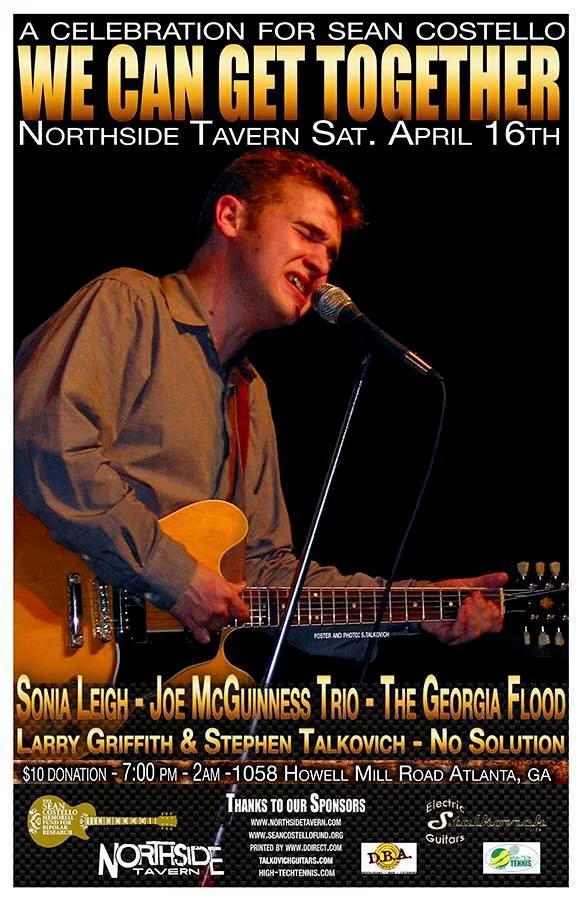
Ray recruited and organized all of the performances and filled in as drummer for almost the entire day. Given that he has been too distraught to listen to Sean’s last CD, We Can Get Together, on which he plays, this was a commitment of pure love for Sean. The sentiments of the Hangen family are apparent on the beautiful poster, where they refer to Sean as their friend and brother. The way that Ray and Gabrielle and their family love Sean is such a tribute to him, that as a mother, I was never more proud or touched.

The day was very warm for Buffalo, and despite the heat, each of the bands played their hearts out. There were so many bands that wanted to play, they were limited to 15 minute sets, and still they came and played. I have never been to Buffalo before. I knew that Sean loved Ray and his family. I can now honestly say that I love them, too. Most of the bands were from Buffalo, and they included:

Jack Civiletto
Allen St. Jazz Band
Acid Funk Duo, featuring Ron Davis and Ray Hangen
Mr. Conrad
Bass Reeves & The Outfit
The Allison Pipitone Band
Mark Winsick Band
The Blues Hounds
Scott Cable
Dave Gross with Gina Sicilia

That Buffalo has a wealth of talent is evidenced by Sean’s choice of musicians in the past few years and was demonstrated to me Sunday. In addition to the talent and generosity of the musicians, many of whom stayed the whole day and contributed generously to the Fund, were the Blues fans of Buffalo. Each person I met was nicer than the next and conveyed a love for Sean the person as well as Sean’s talent. I want to thank Scott Cable who came all the way from North Carolina and was there all day, adding guitar to whomever needed him. A special acknowledgment goes to Gina Sicilia and Dave Gross who drove all the way from DC to participate on Sean’s behalf, arriving late in the evening and putting their heart and soul into their performance. They are obviously talented young blues performers; however, their kind and generous spirits magnified the impact of their performance. Sean was similar in nature and would wish them, as I do, all the best with their careers. All they need is a little luck; talent, looks, personality and work ethic are already apparent.

I cannot thank Ray and Gabrielle enough for the way in which they honored Sean. There are no words to convey how I appreciated their love and caring for Sean and now his legacy. As his mother, I always worried about him when he was on the road. I now know that I had nothing to worry about when he was in Buffalo and I do not doubt that they will keep his memory alive in their hearts. I can ask for no greater gift. Monetarily, the event was a great success, donating as much to the fund as a Blues Festival earlier this spring. Greater than that, to me, is the love they shared with me for Sean. We will never forget Buffalo and the Hangen family, as Sean never did. They will live in our hearts right next to Sean. We hope to use their endeavor to increase our knowledge of Bipolar Disorder and improve outcomes of treatment so that no other Mother has to lose her son through this disease. Sean was a gifted musician, that I knew; however, I am beginning to see that his greatest gift were his friends in the Blues community. I hope to be able to return the gift in some way.

Bipolar Link: http://www.whatadifference.org/

posted by admin on 2008.06.27, under Bipolar Research
27th

Katie, one of Sean’s Buffalo friends, and the artist who did the beautiful poster for their benefit, forwarded the following link to me. Any information like this to the public may be helpful. Please note the statistic that over 18% of 17-25 year olds suffer from some form of mental illness, and they are the ones least likely to seek help. This is the group at risk for co-morbities like addiction, suicide attempts, etc.

The fund is in the process of investigating what education is out there that addresses our concern, and this seems to be one. It is brief but helpful. Will be keeping you informed of our progress.

http://www.whatadifference.org/

www.whatadifference.org

www.whatadifference.org

Bipolar Awareness: Sean’s Story

posted by admin on 2008.05.27, under Bipolar Research, Sean Costello
27th

My decision to start a fund for Sean was a spontaneous one, done while I still had the covers over my head. When I did it though, I opened Pandora’s Box, as this was a very private part of Sean’s life. Why did I do it? I’m not really sure. Sometimes I think it was my ego. I wanted him to stay alive…he was too special for his family and the world to lose so soon. I wanted to use Sean’s gifts of celebrity and kindness to prevent such hurt from affecting anyone else in this world. It would be what Sean would do if he could. Ultimately, I wanted his life to have continued meaning.

The impact of revealing his challenges were an unknown to me, and could have resulted in comments that would be difficult for me to hear, or might negatively influence Sean’s reputation. I underestimated the guidance of my heart, or God or the Universe, whatever is the source of positive inspiration. What has emerged from this endeavor simply validates its inception. So many people have come forward to tell of their experience with Bipolar Disorder. Most of them are complete strangers, but you can hear the sadness in the telling of their own, or the struggles of someone they love or loved. Some of them are family members, who, if I had only known, could have had their history used the information to help Sean in his quest for solutions and diagnosis.

What is Bipolar Disorder?

Bipolar Disorder manifests itself differently in different people, and there are two distinct categories, one where the person is more obviously “manic” and the other, where the person is primarily depressive with hypo manic episodes. Given Sean’s temperament and choice of profession, it is not hard to imagine which category he fell into. The sad thing is that according to statistics, it takes an average of 10 years to accurately diagnose, and during that time, the person affected tries to feel better however they can. Antidepressants don’t work, and can often worsen the symptoms. If symptoms start during adolescence, it is difficult to discern whether the teen has normal teen angst or has a true mood disorder. During this gap, the family and the person affected ride a tumultuous roller coaster, all the while trying to find a way off.

To complicate the matter, there is a shortage of child psychiatrists according to the National Institute of Mental Health and not enough research being done to determine causes and evaluation for early detection. These two are inseparable, for the longer the symptoms, the greater the chance for self-medication, which only worsens outcomes.

One person who wrote of their own trials, called this a “silent illness.” There is no better description. People are not usually willing to admit that they don’t feel the same as everyone else, and the upswing of the disorder fools even the person who is affected. Families are not willing to expose their loved one’s mood swings, both to protect the affected and to avoid feeling different themselves. I cannot tell you how many people have come forward to tell me that they are exhausted from trying to help and support their child or husband, and there seems to be nowhere for them to turn. Add to this a public persona, and silence is common.

Sean is the perfect example of all of these things. As a child, Sean was the opposite of manic; he was down right mellow. He was a gifted student, but was quiet and reserved. It was his sense of humor that revealed his intelligence, and his ability to get into character. When he was in 3rd grade, he came home and told me he was trying out for a part in a play, and he was very excited. I asked him what the part was, and he said “I don’t know, but he says ‘I have a dream’.” He was very blonde and small at the time, so I told him not to be disappointed if he didn’t get the part. Well, he did, and to my surprise, brought the house down even when they took it to the local high school. Both his school and the high school were very racially mixed, and so the reception was very telling of things to come. In class, however, he rarely spoke up and had trouble looking someone in the eye, he was so shy. He did not misbehave. He was as sweet as can be, and, except for exceptionally bad handwriting was an A student. (Funny, this was diagnosed as poor motor coordination! The hand writing never improved, but the hand coordination certainly did.) Although there was no trace of any visible issues, as his Mother, I knew he was extremely sensitive and, at times, fragile and easily disheartened…the guitar got thrown down more than once.

Sean’s shyness continued until he found his guitar. This was his entree into the world of acceptance as a pre-teen, and he was seldom without it. It was a shield, a sort of costume that allowed him to feel like he belonged. Don’t get me wrong, kids loved Sean. He just didn’t know it. He was normal in every way: he teased his sister; never picked up his stuff; hated to do homework; had a ton of kids that would knock for him, etc. But, his sadness often came out only to me and when he wasn’t busy. It’s no surprise that he played the blues. He could look at someone and feel their pain. He was particularly protective of the plight of the African American and their suffering through slavery. Later, having become fluent in Spanish, I found out that he was taking kids who could only speak Spanish for job interviews. (In fact, at the cemetery, a Hispanic woman came to both me and his sister with a card with money in it. She said that Sean had been in school with her son, and she wanted to pay her respects…this was over 10 years later.) He once asked me: “Mom, why can’t I be something cool like Black or Hispanic?” I knew at that moment, that I would never be cool.

In high school, he was in Seventeen Magazine, won the Louis Armstrong Award and was voted best dressed. He had maintained an academic course load with AP classes, while missing about 30 days a year as he toured, mostly to Memphis I tried to get him to slow down, but he told me he had to play the guitar, and other classes were too boring. All of this time, he still struggled with social anxiety, another thing strongly linked to Bipolar Disorder.

You look at Sean and see handsome, talented, gifted, intelligent, generous and sweet. How could there ever be a problem? Well, there was. One he fought to overcome everyday. Lack of self-esteem, social awkwardness and sleep problems were something he lived with until the day he died. Imagine that force on stage in conflict with the awkwardness he felt. The discrepancy in conjunction with the touring, the late nights and the stress of managing a band for more than 12 years took their toll. Nonetheless, those of us who knew him knew he would never give up voluntarily. Never. He was a fighter and he loved too many. However, it is possible that, as his wonderful girlfriend said: “He didn’t leave us. His body left him.”

Sean was considered by many to be a musical prodigy, if not genius, a grouping who, along with artists, are stereotypically bipolar. The medicines which typically help Bipolar Disorder (BPD), however, often leave a person feeling disoriented, tired, like walking “through butterscotch” as Sean said. This is not compatible with performing or creative endeavors, and, as a result, are not acceptable to the artist, certainly not one who performed with Sean’s passion and energy.

Unfortunately. the sad fact is that many musicians do not have health insurance. Sean did. Most musicians don’t make enough money to be the breadwinner. This was intermittent for Sean, but he had a family that could help, although he hated to ask. This gives this population the highest probability of emotional lability with the least ability to afford care.

I have often had people ask me how it felt to have such a gifted child. I could not answer honestly, because what I felt most often was concern and compassion for what it took from him to do what he loved. We go to see bands play and what they have to do to get on the stage is invisible to us. They may have traveled for days (Sean’s last tour went from South Florida to Vancouver, to San Diego and home, with no paying gig after Vegas), eaten crappy food and spent more .. phone calls and gas than they make. Their partners are left home with children and household responsibilities, often with the main job for income and benefits. We don’t want to know that. We want their music for free and their lives on display. They make us feel so much better and ask little in return except maybe attention and maybe applause (tough in a sports bar). Sean was too timid to sell t-shirts!

The odds are stacked against making a living in music, never mind making it big. But, imagine the world without music. Where the passion of a performer is able to connect a crowd full of strangers in a smile or dance. This is a world with no rest for the mind or sustenance for the soul. What else produces a smile, laugh or cry whenever we need and choose to listen? And for the cost of a CD?

I love Sean more than words could ever convey. He was my first and only son and the light of our lives. We knew him as a son, brother and uncle, and music never accompanied our visits. We just loved him for him. I knew what it took from Sean to play, and yet, I also knew he had no choice. It was his destiny. A young death did not have to be, and should never be for anyone else.

For all of these reasons, I ask you to become more familiar with BPD. I ask you to support this cause in Sean’s name. Equally importantly, I ask you to continue to listen to Sean’s music. It’s little recompense for a young man who loved his music, his family, friends and fans and gave them everything without hesitation.

Learn More About Bipolar Disorder – Message From Molly Pellettiere

posted by admin on 2008.05.11, under Bipolar Research, Sean Costello
11th

“Sorry” just doesn’t cut it when things like this happen. But, I am. So truly sorry for your loss. Hold on to those memories of good times. I’m glad you had them with him. He seems like he was a wonderful young man. Our loss of Sean the “performer” is but a drop in the bucket compared with your loss of him as a son.

Working in the mental health field, I see folks struggle all the time to maintain some kind of even playing field. And, even though I understand the science of it all, I still don’t “understand” why the cards get dealt the way they do sometimes. I guess the trick is to strive to figure out the best way to play the hand we’re holding each day.

While I personally don’t suffer from bipolar disorder, I do know that it is one of the more difficult conditions to treat and that much work still needs to be done in order to find something to help with the symptoms effectively and consistently.

Personally, I have had to deal with addiction and depression, which have both had their moments on top, believe me. When we discover that self-medicating isn’t really working for us, and then we turn to the medical community only to realize that their answers are less than perfect also – we can find ourselves even more frustrated and discouraged.

However, I know that the advances that have been made in recent years in the treatment of neuro-chemical disorders such as addiction, schizophrenia, depression, anxiety and bipolar have been phenomenal, especially considering the treatments of the past. Often times some of these as co-occuring. And, it is important to understand – these are dysfunctions of the brain itself. These aren’t weaknesses or failings of the persons who have them. They are BRAIN DISORDERS. And, like other diseases, some folks have far more severe symptoms than others.

Much work still needs to be done in the diagnosis and treatment of these brain disorders. This is why foundations such as the Sean Costello Memorial Fund for Bipolar Research are so important. The more we can learn about these disorders, the better the treatments and interventions will be for them.

One statement that I have found is universally shared by all of those dealing with these types of issues is: “Sometimes I feel the most alone when I am surrounded by a crowd.” Many of us can relate to this.

For anyone who is interested in learning more about Bipolar Disorder, please see the National Institute of Mental Health’s information at:

http://www.nimh.nih.gov/health/publications/bipolar-disorder/complete-publication shtml

I applaud you for coming forward and out of the shadows about this. It is only through more openness and public education and awareness that those dealing with these disorders and their loved ones will feel comfortable in sharing with others what is going on with them and in getting the support they need. I pray that you all find love and support as you deal with Sean’s death and in spreading the word through the foundation. Thank you for sharing all of this with us.

As a fan, I know I’ll be forever grateful for the breath of fresh air he breathed into the blues.

Peace ~ Molly PELLETTIERE, Kansas City

pagetop